



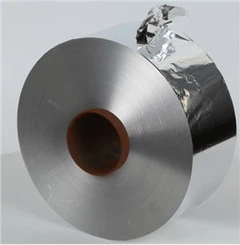


Yo! I'm an aluminum foil jacket supplier, and today we're gonna dig into the thermal conductivity of aluminum foil jackets. It's a topic that might not sound super exciting at first, but trust me, it's pretty important, especially if you're in the market for this kind of product.
First off, let's talk about what thermal conductivity actually means. In simple terms, it's a measure of how well a material can conduct heat. A material with high thermal conductivity can transfer heat quickly, while one with low thermal conductivity is more of an insulator and slows down the heat transfer.
Aluminum is known for being a good conductor of heat. That's why it's used in so many applications where heat needs to be moved around, like in cooking pans and heat sinks for electronics. When it comes to aluminum foil jackets, this property of high thermal conductivity is both a blessing and a curse, depending on how you're using it.
The thermal conductivity of pure aluminum is around 237 W/(m·K) at room temperature. But when it comes to aluminum foil jackets, the actual thermal conductivity can vary a bit. That's because the foil might not be pure aluminum; it could have some alloying elements added to improve its strength, flexibility, or other properties. These alloying elements can slightly reduce the thermal conductivity.
For example, if you're using an aluminum foil jacket to wrap around a hot pipe to keep it insulated, the high thermal conductivity can be a problem. You want the jacket to act as a barrier and prevent the heat from escaping. In this case, you might need to use a foil with a lower thermal conductivity or combine it with an insulating material.
On the other hand, if you're using the aluminum foil jacket in a situation where you need to transfer heat quickly, like in a heat exchanger, then the high thermal conductivity is a huge advantage. The foil can efficiently transfer the heat from one side to the other, making the heat exchanger more effective.
Now, let's take a look at some of the products we offer as an aluminum foil jacket supplier. We have a wide range of options, each with its own unique properties.
One of our popular products is the 8011 Household Foil For Microwave. This foil is designed specifically for use in the microwave. It has just the right balance of thermal conductivity and other properties to make it safe and effective for heating up your food.
We also have the Raw Material For Making Household Aluminum Foil. This is the starting point for creating high - quality aluminum foil products. The thermal conductivity of the raw material is carefully controlled to ensure that the final product meets the desired standards.
And then there's our Baking Barbecue Aluminum Foil. This foil is great for baking and barbecuing. Its thermal conductivity allows it to distribute heat evenly, so your food cooks perfectly every time.
But how do we measure the thermal conductivity of our aluminum foil jackets? Well, there are several methods. One common method is the guarded hot plate method. In this method, a sample of the foil is placed between a hot plate and a cold plate. The heat flow through the sample is measured, and using the temperature difference between the two plates and the thickness of the sample, the thermal conductivity can be calculated.
Another method is the transient hot - wire method. This method is a bit more complex, but it can provide quick and accurate results. A thin wire is placed in contact with the foil sample, and an electric current is passed through the wire to heat it up. The rate at which the wire cools down due to heat transfer to the foil is measured, and from this, the thermal conductivity of the foil can be determined.
Now, you might be wondering how all this information about thermal conductivity affects the performance of your project or product. Well, if you're using an aluminum foil jacket for insulation, you want a lower thermal conductivity. This means that less heat will escape, and your insulation will be more effective.
On the other hand, if you're using it for heat transfer applications, a higher thermal conductivity is better. You'll be able to move heat more quickly and efficiently.
We understand that every customer's needs are different. That's why we offer a variety of aluminum foil jacket products with different thermal conductivities. Whether you're a large industrial company or a small household user, we've got you covered.


If you're interested in learning more about our aluminum foil jackets and how their thermal conductivity can meet your needs, we'd love to talk to you. Contact us to start a conversation about your requirements, and we can help you find the perfect product for your project.
In conclusion, the thermal conductivity of an aluminum foil jacket is an important factor to consider when choosing the right product. It can have a big impact on the performance of your applications, whether it's for insulation or heat transfer. So, make sure you understand your needs and choose a product with the appropriate thermal conductivity.
References
- Incropera, F. P., & DeWitt, D. P. (2001). Fundamentals of Heat and Mass Transfer. Wiley.
- Çengel, Y. A. (2003). Heat Transfer: A Practical Approach. McGraw - Hill.